

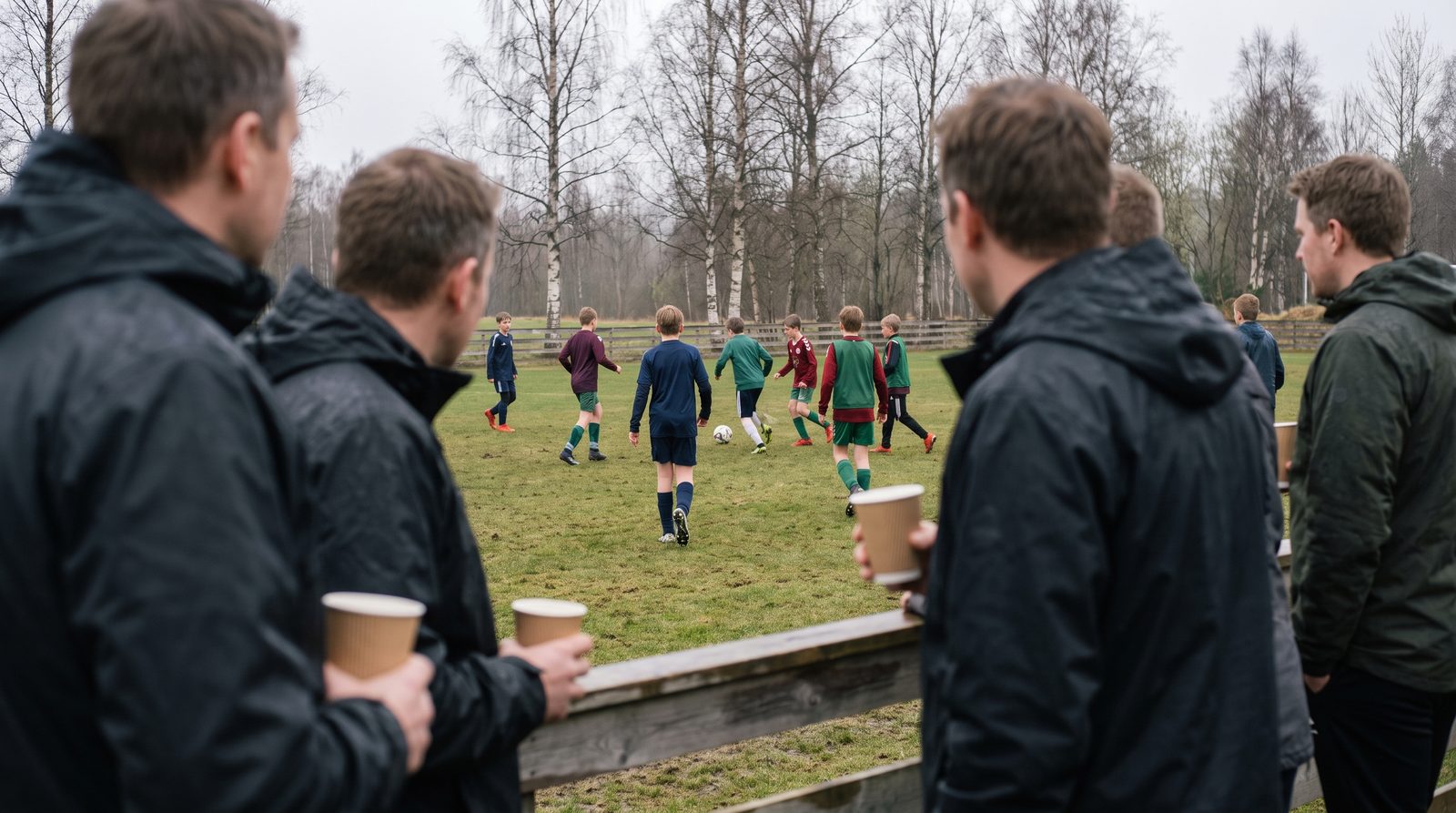
The parent on the sideline: how adults can help without getting in the way
Parents on the sideline always mean well, but well-meaning shouting is not the same as help. Here is why children lose their own voice when adults coach, four habits any parent group can agree on, and how the coach sets the frame.
The sideline is part of the pitch
For a nine-year-old, the sideline is not an audience. It is a voice right in their ear, three metres away, in the middle of a moment where their brain is already working flat out. The child has to read the game, find a teammate, remember what the coach said at half-time — and at the same time work out who is shouting "SHOOT!".
Almost every parent means well. That is exactly why it is worth saying out loud: on the sideline, well-meaning is not the same as helpful. An instruction from home that cuts across what the coach has drilled all spring does not make the child better. It makes the child confused.
The three voices
During a match, three voices compete for space in a child's head:
- The coach's voice — the one with a plan, and the one that should be in charge.
- The parents' voice — the one the child is most emotionally attached to, and therefore listens hardest for.
- The child's own voice — the one we are actually trying to build, because that is what makes a player independent.
When voice number two takes over, voice number three disappears. Children who get shouted instructions for fifty minutes stop making their own decisions. They start playing to avoid being told off instead of solving the problem in front of them.
Four habits that lift the sideline
This is not a sermon. These are practical habits a parent group can agree on in five minutes at a parents' meeting:
- Cheer, do not coach. Applause, names and "good try" are always fine. Tactics and positioning are the coach's job.
- Praise what you want to see more of. Comment on the work that never reaches the scoreboard: winning the ball back, lifting a teammate up, a brave pass that was the right choice even though it did not come off.
- Be quiet in the deciding second. When the child has the ball, they need calm to think. Shout before and after, not during.
- Leave the referee alone. In youth football the referee is often fourteen years old. How adults speak to the referee is the simplest measure of a team's culture.
The drive home
The most important conversation on match day does not happen on the sideline. It happens in the car afterwards, and the rule there is simple: ask, do not assess.
"Did you have fun?" and "What was the best bit today?" open the door. "Why did you let him past there?" closes it. Many children need twenty minutes of silence before they want to talk about the game at all, and that silence is not sulking — it is recovery.
One team at Solsiden IL made a simple agreement: no football talk on the drive home unless the child starts it. Half the parent group thought it was odd. Six months later, nobody wanted to go back.
The coach's responsibility
Parents guess when they are not told. So it is the coach who has to set the frame, not the other way around:
- Explain early in the season what the team is working on, and why it will look messy for a while.
- Explain how squad selection and playing time are decided — before anyone has time to wonder.
- Give parents a job. Match host, kiosk duty, driving. A parent with a role shouts less.
- Say thank you. The parent group is not a problem to be managed; it is the team around the team.
Openness is what turns the volume down
Almost all sideline noise comes from uncertainty: is my child playing enough, does anyone notice her, do the same rules apply to everyone? When the answer is visible, the question goes away.
That is why MyTeams lets you share the squad, playing time and match statistics with the parent group straight from the app. Not to prove anything, but because a parent who can see the numbers stands calmer on the sideline — and then the kids get their own voice back.

