

Children's Football: What Coaches and Parents Should Know
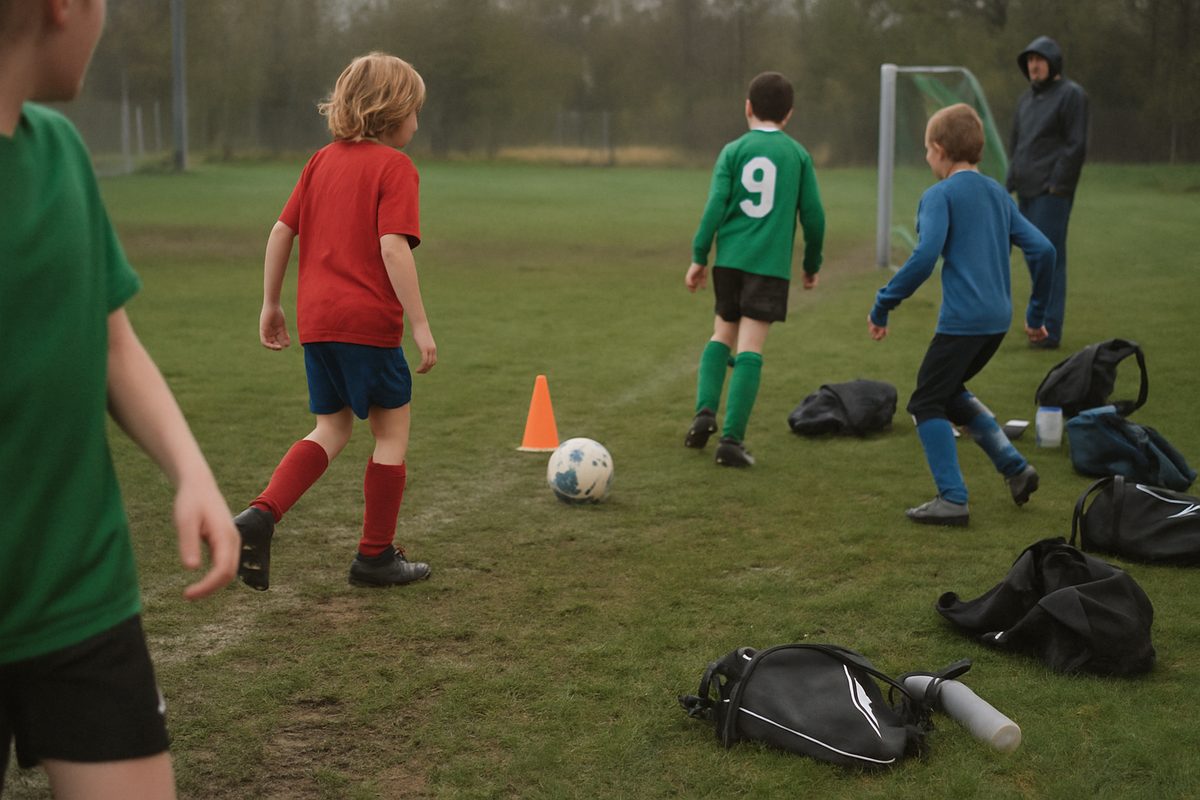
Children's football is about creating positive experiences where everyone gets to play and develop at their own pace. Here's what coaches and parents need to know about playing time, team composition, and how we build confidence around the youngest players.
What is children's football?
Children's football in Norway covers age groups 6–12 years, divided into 3v3, 5v5, 7v7 and 9v9 formats depending on age. The Norwegian Football Federation's guidelines emphasise that everyone should get equal playing time regardless of ability level, and that results should not be the focus. This means concretely that coaches cannot substitute weaker players to win matches, and that league tables and cup winners should not be highlighted as the main goal.
For 6-year-olds the format is 3v3 without a goalkeeper, for 7-9 years it's 5v5, and only from age 10 do teams move to 7v7 football. These formats ensure that everyone gets many touches on the ball and stays involved in the game, which is crucial for learning.
Equal playing time in practice
Equal playing time means that everyone on the team should play roughly the same amount over a season. In practice, many coaches solve this through systematic rotation: if the team has 12 players and plays 7v7 football, you can divide them into two groups that switch every 10 minutes. Write down the rotation before the match so you don't have to think about it during play.
Some parents ask whether their child can play more because they're better or more motivated. Here the coach must be clear: "In children's football we follow the NFF's guidelines on equal playing time. That gives everyone the best development." Experience shows that players develop at very different rates, and the one struggling at age 8 can be among the best at age 12.
Remember that equal playing time also applies to positions. Don't let the same player stay in goal every match – rotate so everyone tries different roles.
Team composition and ability grouping
Some clubs create A and B teams from age 9. This is permitted, but the NFF recommends waiting until 11-12 years. The argument is that early ability grouping can damage motivation for those who end up on the B team, whilst those on the A team get a one-sided focus on results.
If your club has several parallel teams in the same age group, consider mixing the teams regularly – for example every three months. Imagine a team where the five strongest players always play together: the weaker ones don't get enough challenge to develop, and the strongest don't get the challenge of lifting others.
Regarding girls and boys, they can play together until age 12 without problems. Many girls benefit from playing with boys at this age, and vice versa.
Training over matches
In children's football there should be substantially more training than matches. A rule of thumb is two training sessions per week and one match. Matches are important for motivation, but it's in training that players learn technique, get many repetitions and try new things without pressure.
At training everyone should get equal touches on the ball. Avoid drills where half the team stands in a queue – instead use multiple stations or smaller groups. If you have 14 players, divide them into groups of 4-5 so no-one waits long for their turn.
Keep the exercises simple and varied. 8-year-olds don't need complex tactical setups, they need to take many shots, dribble a lot and play small games where they're constantly involved.
What parents can do
The parents' role is to support, not to coach from the sideline. Concretely this means letting the coach give instructions during matches, and yourself focusing on encouragement: "Well done!", "Keep going!". Avoid shouting instructions about passes or positions – it confuses players who are trying to listen to the coach.
After matches, ask what your child thought was fun, not whether they won or scored. "What was the most fun today?" creates better conversation than "Why did you miss that chance?". Children who experience that their parents care more about effort and enjoyment than results stay in sport longer.
If you disagree with the coach's choices – for example that your child got too little playing time in one match – take it up privately with the coach afterwards, never in front of the players or other parents. Most misunderstandings are resolved quickly when people talk together.
When the transition to youth football approaches
From age 13, youth football begins, where the competitive element becomes clearer and equal playing time is no longer a requirement. This transition can be challenging for players who have been used to guaranteed playing time.
Prepare players for this already at age 11-12 by talking about how football changes: "From next year there will be more competition for places, and playing time must be earned at training." At the same time: don't introduce this too early. Children at age 10 still need the security of knowing they'll play regardless.
For coaches leading 12-year-olds in the spring before they turn 13 in the autumn: use the season to build basic skills and confidence, not to start with A-team mentality. The players have their entire youth football career ahead to work on competitive mentality.

